Microsoft AI published a six-word summary of its new speech models on 1 October: “accurate, fast, low cost, and chart-topping audio understanding and generation”. Three of those claims are checkable against a public leaderboard the company itself cites. One of them is not true.
This is a recount rather than a rebuttal. The accuracy claim is the big one, it is the one a competitor would most want to dispute, and it survives everything I could throw at it — including, in one case, by a wider margin than Microsoft claimed for itself. The claim that fails is the quiet one in the middle of the list.
The claim, split into its parts
The launch post makes four separable assertions about MAI-Transcribe-2-Streaming:
- “It ranks no. 1 for accuracy for both final and partial transcripts on Artificial Analysis.”
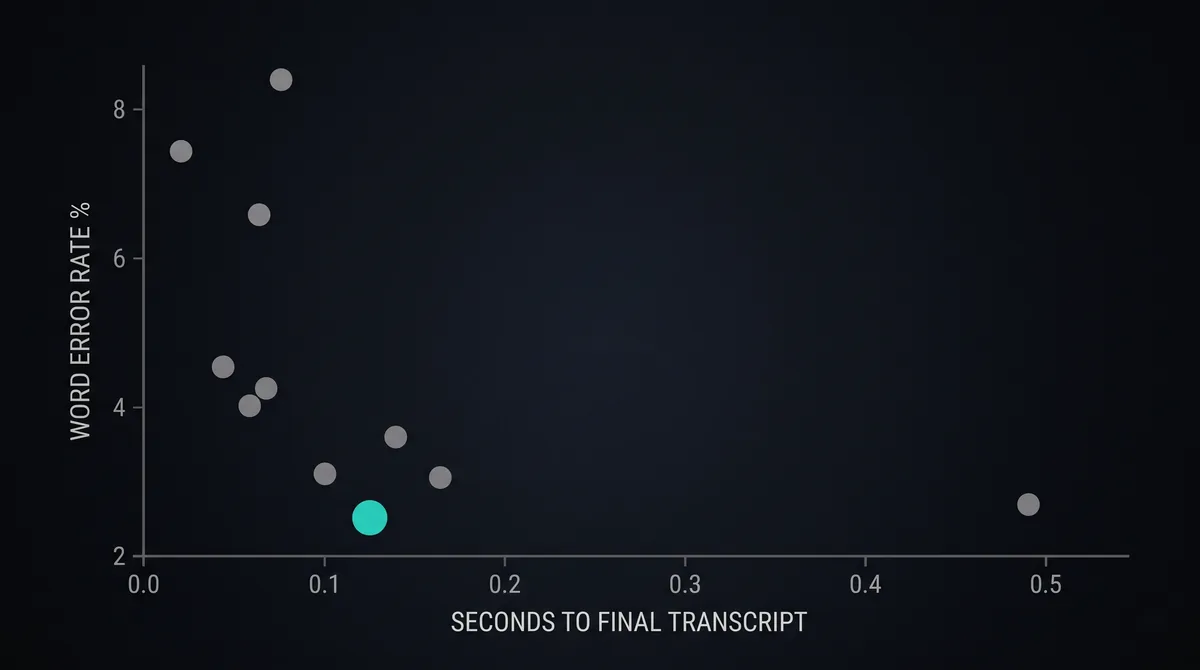
- “on its accuracy-versus-latency evaluation, we sit on the Pareto frontier, showing that higher accuracy doesn’t have to come with a hefty latency tradeoff.”
- “our internal evaluations show that words appear in the transcript 2x faster than with our closest competitor.”
- The header’s “low cost”, and the body’s “introductory price of $0.54 per hour of audio through the end of the year.”
Claims 1 and 2 name a third party, so they can be audited. Claim 3 names its own harness and cannot be. Claim 4 is a comparative adjective with a leaderboard column attached to it.
Artificial Analysis publishes a streaming speech-to-text board whose index, AA-WER Streaming, is a weighted blend of three datasets: AA-AgentTalk at 50%, VoxPopuli at 25%, Earnings22 at 25%, with latency timed from detected end of speech. I pulled the board’s underlying data on 5 October and counted all 38 entries rather than reading the top of the chart.
One: no. 1, twice, and it is not close
On final-transcript accuracy, MAI-Transcribe-2-Streaming posts an AA-WER Streaming index of 2.514%. That is first of 38. Zero entries are more accurate.
On first-partial accuracy — the number for the harder problem, since a partial is emitted before the speaker has finished the sentence — it posts 2.516%, also first of 38. The runner-up there is Grok Voice Transcribe 2.0 at 3.359%, and Meta’s Muse Voice Transcribe at 3.575%.
The detail worth more than the ranking is the gap between those two MAI figures: 2.5136% final against 2.5163% partial, a difference of 0.0027 percentage points. The provisional transcript is as accurate as the committed one. Microsoft’s framing of why that matters is “These partials enable voice-enabled applications to act on speech before the speaker even finishes” — and on this board, that is a claim its own numbers earn. Most competitors degrade sharply on partials: Alibaba’s Qwen3 ASR Flash Realtime goes from 3.734% final to 19.945% partial, and Grok Voice Transcribe 1.0 from 3.933% to 18.275%. Those models give you an early guess you cannot act on.
Claim 1 verifies, in both halves.
Two: the Pareto claim holds, and the counting is the proof
A Pareto-frontier claim is a negative one: nothing beats you on both axes at once. It is also the claim most often made loosely, so it needs the full table.
MAI-Transcribe-2-Streaming returns a final transcript 0.128 seconds after end of speech. Ten of the 38 entries are faster, several dramatically so — Deepgram Flux at 0.021s, Soniox v5 at 0.054s, Cartesia Ink-2 external endpoints at 0.067s. Of those ten faster models, the number that are also more accurate is zero. The best WER among them is Cartesia Ink Preview external endpoints at 3.111%, well behind MAI’s 2.514%.
So the frontier claim is correct as written.
Three: the unauditable claim, which understates the public board
Claim 3 is explicitly Microsoft’s own: “our internal evaluations show that words appear in the transcript 2x faster than with our closest competitor”. There is no harness, no competitor name and no methodology, so I cannot check it and am not going to treat it as checked.
What I can say is that the public board is more flattering than the private claim. Taking “closest competitor” to mean the nearest model on accuracy — Grok Voice Transcribe 2.0, the only other entry under 2.8% WER — MAI reaches a final transcript in 0.128s against Grok’s 0.490s. That is 3.84x, not 2x.
This cuts against my own expectations, and it belongs in the piece for that reason. A vendor rounding down on itself is the opposite of the pattern this site usually finds, and reporting only the gaps that embarrass a company would be advocacy rather than auditing.
Four: “low cost”, counted
MAI-Transcribe-2-Streaming is listed at $9.00 per 1,000 minutes of audio, which is the $0.54 per hour from the launch post. Sorted by price, it is 29th cheapest of 38. Twenty-eight entries cost less. It ties Google’s Gemini 3.5 Transcribe Live at $9.00; eight entries cost more.
Some of the cheaper ones are genuinely competitive. Meta’s Muse Voice Transcribe is third on accuracy at 3.062% and costs $3.00, a third of the price. Grok Voice Transcribe 2.0, the accuracy runner-up, costs $3.33. NVIDIA’s Nemotron 3 ASR variants are open-weight and listed at $0.00.
The board makes the point itself, in a way I did not expect to find. Each entry carries display flags marking which columns the leaderboard considers notable for that model. For MAI-Transcribe-2-Streaming, highlightStreamingFinalWer is true and highlightStreamingLatency is true. highlightStreamingPrice is false. The leaderboard flags the two claims that hold and declines to flag the third.
For context on how the word is being used: Microsoft’s own batch MAI-Transcribe-2 announcement from 3 September says “the best price on the market, just $0.10 per hour of audio” — and that one is a price claim with a superlative on it. The streaming model is 5.4 times that price. “Low cost” in the streaming header is doing work that the September post’s number cannot support.
The word the launch post never uses
One more divergence, and it is not about numbers.
The launch post lists what you can do with the model now: “The applications keep expanding, but developers can build these today”, followed by “Customer service agents that transcribe requests as they’re spoken, begin acting before the caller finishes, and respond in natural speech”.
The developer documentation opens differently: “This feature is currently in public preview. This preview is provided without a service-level agreement, and is not recommended for production workloads. Certain features might not be supported or might have constrained capabilities.”
The word “preview” does not appear in the launch post once. Neither document is dishonest — one is written for someone deciding whether to try a model, the other for someone deciding whether to route live customer calls through it. But a contact centre is a production workload, and the page that tells you so is not the page you were sent to first.
What a buyer should take from this
The accuracy result is real, independently measured, and stronger than the headline in the one place I could test it harder. If transcription quality under streaming conditions is the binding constraint, this is currently the best-measured option of 38, and the partial-transcript parity is a genuine capability rather than a benchmark artefact.
The two things to carry into a procurement conversation are that it is the 29th-cheapest entry on the board that certifies its accuracy, and that the documentation withholds a production SLA. Neither is hidden. Both are one click from the announcement, and neither is in it.