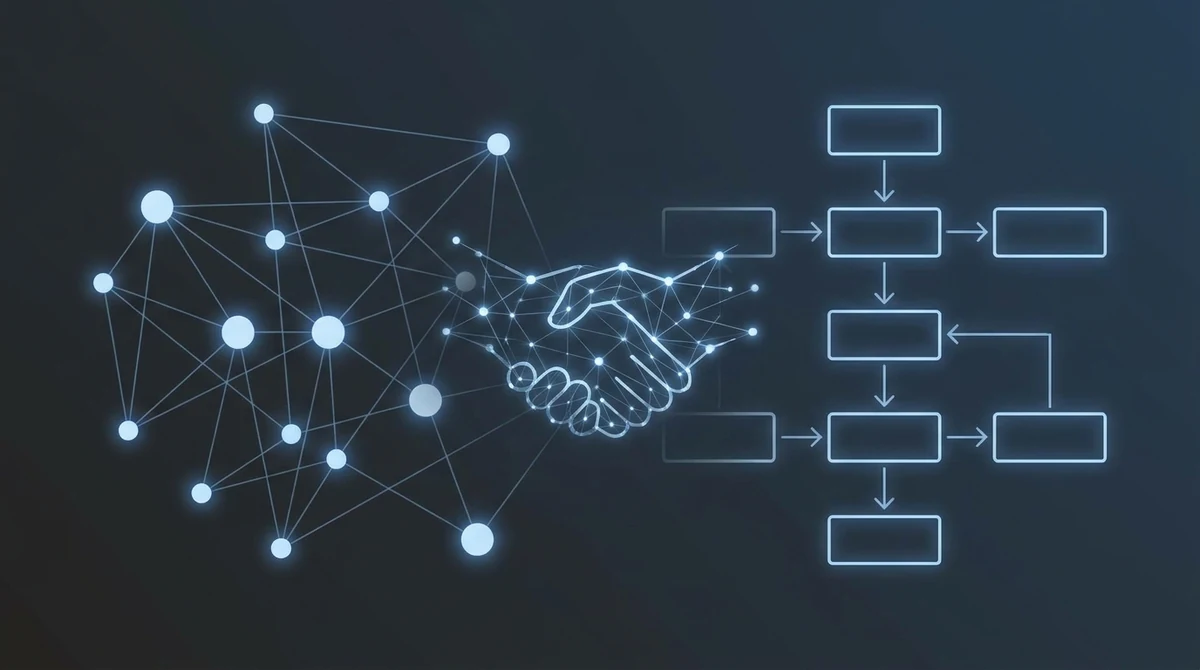
A 35-author academic paper says this is a new paradigm for AI agent systems. The company that built the tool for exactly this pattern three years ago says it’s the latest name for something they’ve already been doing the whole time. Both are citing the same underlying idea — “Graph Engineering” — and both have a point.
The academic case
A paper published on arXiv in August 2026, “Graph Engineering in the Era of LLM Agents,” argues that individual agent intelligence “faces a fundamental limit” once tasks require “heterogeneous expertise, interdependent subtasks, parallel execution, independent verification, and persistent state” (arXiv 2608.21156). The paper’s proposed fix: “Graph Engineering… constructs explicit, dynamic, evolving graph structures representing tasks, agents, and system states” — treating the coordination layer between multiple agents as something to deliberately design, not something that emerges accidentally from stacking agents together. It’s framed as the successor in a lineage: after Prompt Engineering, Context Engineering, Harness Engineering, and Loop Engineering, this is presented as the next rung.
The pushback, from the people who’d built the thing for three years
LangChain’s own response, published a month before the arXiv paper (a coincidence of timing worth noting, not a direct rebuttal to that specific paper), doesn’t dispute the underlying idea — it disputes the novelty. “Graph engineering isn’t a new idea. It’s the latest name for a well established approach to building reliable agents,” the post states plainly, pointing out that LangGraph, “downloaded 65M+ times a month,” has represented agent systems as graphs — nodes doing work, edges deciding what happens next — since 2023 (LangChain).
Where they actually agree
Read past the disagreement over the label, and the two sources describe the same mechanism almost identically. LangChain: “a graph gives you a concrete way to define the workflow an agent follows… it lets you more tightly control behavior when you want the agent to follow specific paths.” The arXiv paper’s framing of “explicit, dynamic, evolving graph structures” is describing the same thing in more formal, academic language. Where LangChain adds real nuance the paper’s abstract doesn’t cover: “agent graphs are usually not DAGs” — production systems need cycles (retrying failed calls, looping until enough context exists), and “loops are simple graphs,” not a separate category from them.
What LangChain says is actually new
If there’s a real, non-relabeled shift happening, LangChain’s own post identifies it precisely: “what’s changed is what you can put inside a node. Early on, nodes were deterministic code or a single LLM call. Now that agents themselves are reliable enough to trust with real work, a node can be a full agent run — you’re orchestrating agents, not just LLM calls.” That’s the part worth taking seriously regardless of which side of the “is this a new paradigm” argument someone’s on: coding agents good enough to embed as a single node inside a larger, more deterministic graph is a genuinely newer capability than the graph-as-structure idea itself.
Why this matters
The label fight is mostly noise; the substance underneath it is a real design question every team building multi-agent systems eventually hits — how much of the coordination logic should be deterministic code with the LLM’s judgment confined to specific nodes, versus how much should be left to an agent’s own open-ended reasoning loop. LangChain’s own guidance is concrete on this: use graphs when the workflow has predictable structure (classify, search, synthesize); skip them for genuinely open-ended tasks like deep research, where they themselves moved away from a fixed graph toward a more agentic core loop. Whichever term wins, that’s the actual decision worth understanding.