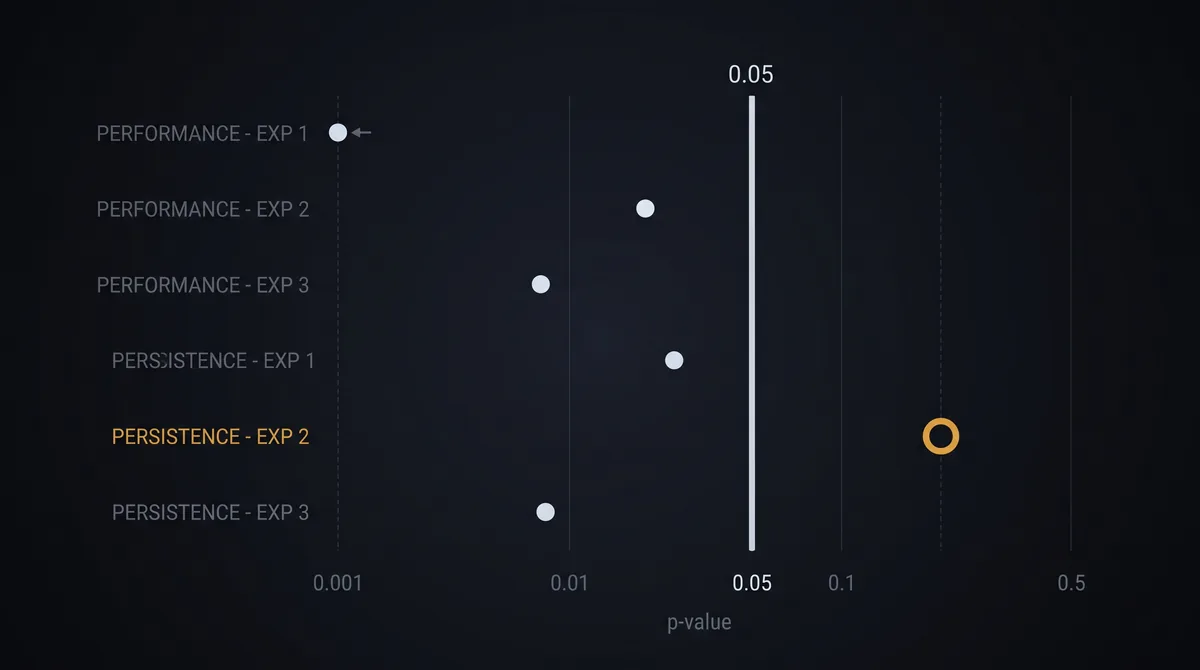
One sentence in the current version of this paper does not appear in any coverage of it: “but the result was not significant.” It is about persistence, which is the finding the paper is named for, and it sits in the experiment the authors built specifically to be the trustworthy one.
The paper is AI Assistance Reduces Persistence and Hurts Independent Performance by Grace Liu (Carnegie Mellon), Brian Christian (UC Berkeley), Tsvetomira Dumbalska (Oxford), Michiel Bakker (MIT) and Rachit Dubey (UCLA), revised to v5 on 3 October 2026 and presented this month at the Conference on Language Modeling. It is a serious piece of work: three randomised controlled trials, 1,222 participants recruited through Prolific, stated exclusion criteria, and an appendix analysis that attacks its own result. Nothing below disputes that.
What it does dispute is that the title names two findings, and the evidence for them is not equally strong.
Two claims, not one
The abstract states the pair plainly: the trials provide “causal evidence for two key consequences of AI assistance: reduced persistence and impairment of unassisted performance.” Those are two different variables. Impairment is the solve rate on the final three problems, after the AI sidebar is taken away without warning. Persistence is the skip rate on those same problems, using a skip button participants were told carried no penalty, which the authors argue makes skipping “a clear measure of motivation and persistence, independent of ability.”
So each experiment returns two verdicts, and they can be counted separately. There are three experiments, so six verdicts.
The impairment half: three for three
Experiment 1, 307 participants after exclusions, fraction arithmetic: the AI group’s test solve rate was 0.57 against the control group’s 0.73, p < 0.001.
Experiment 2, 585 participants, the same task with a pretest added and a sham sidebar for the control group: 0.71 against 0.77, p = 0.020.
Experiment 3, 168 participants, SAT-style reading comprehension: 0.76 against 0.89, p = 0.007.
Three for three, two task domains, consistent direction. The appendix pushes harder still: restricting Experiment 2 to participants who solved all three pretest questions correctly leaves 0.85 for controls against 0.78 for the AI group, p = 0.03. The deskilling half of this paper is about as well supported as a three-trial result gets, and anyone reaching for “the samples self-selected” should read Appendix C.4 first, because the authors got there already.
The persistence half: two for three, and the miss is the biggest trial
Experiment 1: AI skip rate 0.20 against control 0.11, p = 0.031. Significant.
Experiment 3: 0.08 against 0.01, p = 0.008. Significant.
Experiment 2: 0.10 against 0.07, and here is section 3.2 in full. “Participants in the AI condition also exhibited a higher skip rate (mean 0.10, s.d. 0.26) than participants in the control condition (mean 0.07, s.d. 0.23; t(583) = 1.18, P = 0.239; Cohen’s d = 0.10, 95% CI [-0.07, 0.26]), but the result was not significant.”
The confidence interval crosses zero. And Experiment 2 is not a stray trial at the edge of the paper. It has 585 analysed participants against 307 and 168, and it exists because Experiment 1 had a flaw the authors name themselves: Experiment 1 excluded people who could not solve basic fractions unaided, but kept people in the AI group who had cleared that bar by submitting the assistant’s answers, so “the AI condition could have selectively retained lower-ability participants.” Experiment 2 fixed that with a pretest, and gave the control group a sidebar of already-seen worked solutions so both conditions had something removed rather than only one. Both changes make it the cleaner design. It is also the one where persistence came back null.
The appendix agrees rather than rescuing it. Restricted to the strongest participants, Experiment 2’s skip gap is 0.07 against 0.05, “though the difference is not significant (P = 0.47).”
The rescue analysis, and what it is labelled
Section 3.3 is the paper’s answer, and it is the most interesting thing in it. Asked afterwards how they had used the assistant, 61% of the AI group, N = 189, “self-report that they used the AI primarily to get answers directly”; 27% used it for hints and clarifications; 12% did not use it at all, which chat logs corroborate for 83.8% of that group. Split that way, the participants who took direct answers skipped more at test than controls, 0.13 against 0.07 at p = 0.033, and more than the hint group, while no group differed significantly from any other at pretest. On this account the aggregate null is dilution: a third of the condition behaving one way and two-thirds the other, averaged into one number.
That is plausible, and it is a better description of how people use these tools than the condition-level comparison is. It is also, in the authors’ own sentence at the head of that section, a different class of evidence: “These results focus on the AI-assisted subset of our RCT data and are cross-sectional in nature; therefore, the findings below are not necessarily causal.” Self-reported usage, collected after the fact, partitioning a randomised sample into groups nobody randomly assigned. The causal claim in the abstract rests on the between-condition comparison, and in the largest trial that comparison returned p = 0.239.
Where the caution lives
Coverage compresses in a predictable direction. UC Berkeley’s write-up of 9 October reports that ten minutes of reliance on an AI tool “significantly impairs our ability to focus and persist with difficult tasks”, and its photo caption repeats it as impairing “the user’s ability to focus and persist”. One verb, two findings, a single significance claim stretched across both. It is accurate for performance and ahead of the evidence for persistence.
The paper itself does not do this. Its introduction says: “We urge caution in interpreting these results as broad evidence that AI lowers persistence and independent ability for all tasks.” Its limitations section says the trials “captured only brief AI exposure”, that “we cannot speak to the durability of these effects: participants were tested immediately after AI removal”, and that “our AI was maximally helpful, providing complete answers on demand” - an assistant pre-loaded with every problem and its solution, which answers the prompt “answer?” with the answer. That is a deliberate upper bound on offloading, not a description of any product a reader uses.
Five significant results out of six, one null in the largest trial, and every caveat above quoted from the authors rather than argued against them. The gap worth noticing is not between this paper and its critics. It is the distance a finding travels between the paper and the page written about the paper.